Sanlien Seismic and Vibration Monitoring Portfolio for Real-Time Monitoring & Early Warning Systems

Sanlien Seismic and Vibration Monitoring Portfolio for Real-Time Monitoring & Early Warning Systems

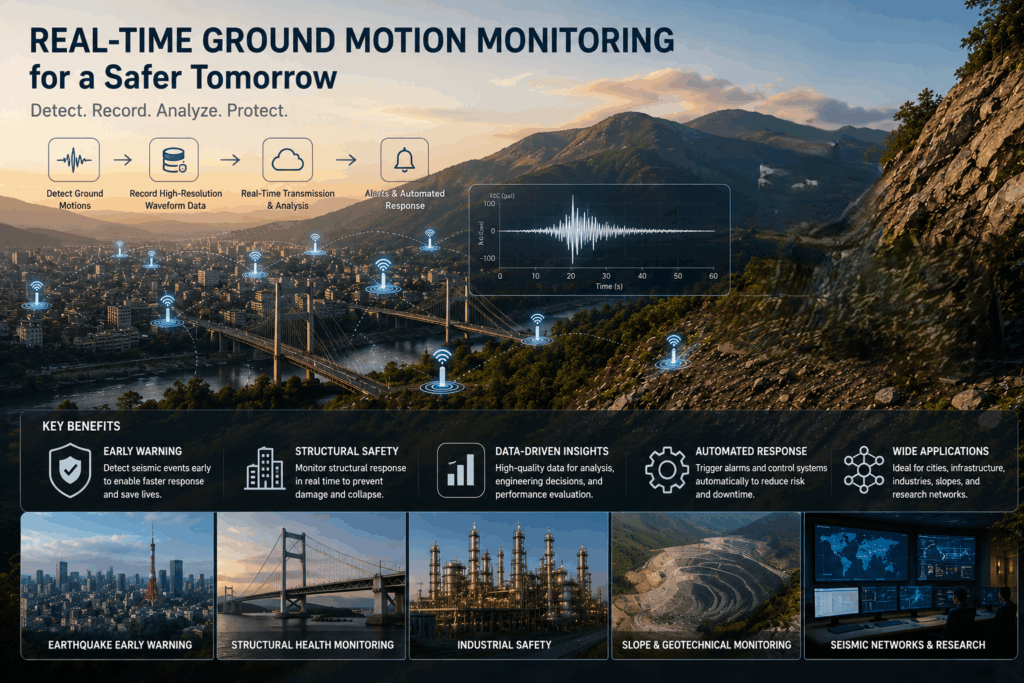
A seismic accelerograph plays a key role in modern seismic monitoring systems. It measures ground motion and records high-resolution waveform data during seismic events. When deployed as part of a real-time monitoring network, it becomes a critical data source for earthquake early warning systems, structural health monitoring, and engineering analysis. Engineers and operators use this information to assess structural safety, reduce risk, and respond more effectively to seismic activity. This article explains how Sanlien’s product portfolio is structured and how these systems are deployed in real-world applications such as earthquake early warning, structural health monitoring, and industrial safety.

1. What is a seismic accelerograph?

A seismic accelerograph is an instrument used in modern seismic monitoring systems to measure ground motion and record high-resolution waveform data during seismic events. The recorded data can be used for analysis, real-time transmission within monitoring networks, and supporting automated structural safety responses.

The device integrates two core functions into a single system:

  • An accelerometer sensor: detects and converts ground motion into an electrical signal
  • A data recorder: digitizes, timestamps, stores, and transmits that signal in real time
  • A data acquisition and recording unit: digitizes, timestamps, stores, and transmits waveform data in real time


When deployed as part of a networked monitoring system, seismic accelerographs become a critical data source for earthquake early warning systems, structural health monitoring, and engineering safety applications.

Together, these functions form the foundation of modern seismic and structural monitoring infrastructures.

2. Sanlien Seismic and Vibration Accelerograph Product Lines

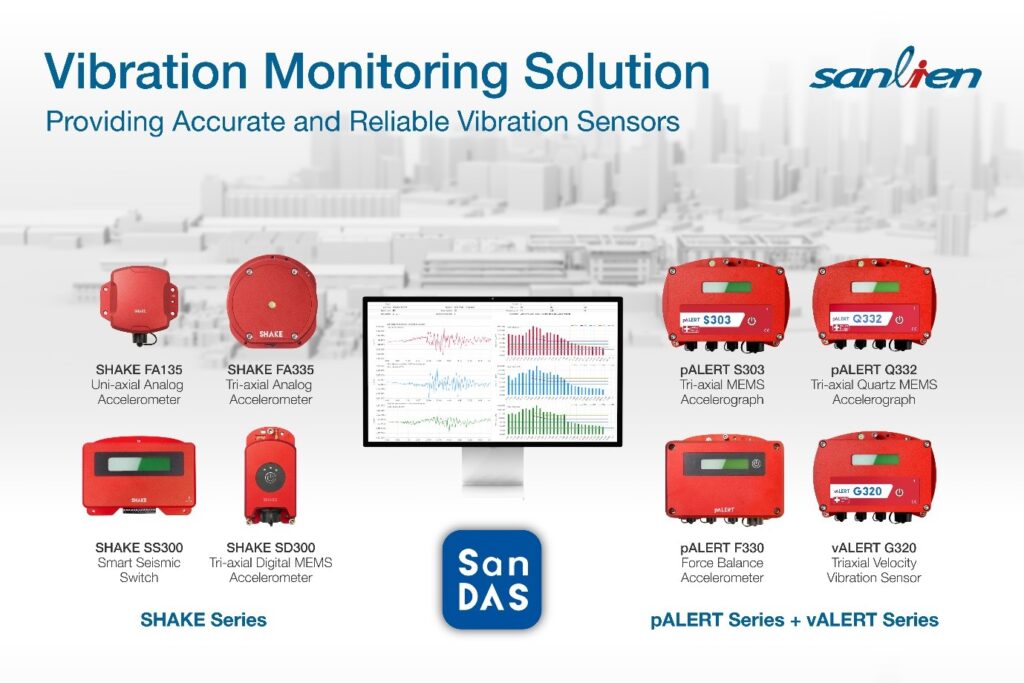
Sanlien offers a comprehensive range of seismic and vibration accelerograph solutions designed for real-time monitoring networks, earthquake early warning, structural health monitoring, and industrial safety applications.

2.1 pALERT series – Network accelerometer

Meet the pALERT Network Accelerometer, a seismic monitoring device equipped with advanced P-wave alarm technology. Developed in collaboration with Prof. Yih-Min Wu of National Taiwan University, it leverages Pd-based detection technology to issue alerts within seconds of detecting P-waves.

The pALERT system incorporates multiple trigger algorithms—including Pd, PGA, and STA/LTA—to ensure accurate and adaptable performance across diverse seismic conditions. Designed for both on-site and regional Earthquake Early Warning System (EEWS) deployments, it supports a wide range of real-time monitoring applications.

To ensure precise event timing, pALERT features time synchronization via Network Time Protocol (NTP) or a PC-based utility. Built with IoT integration capabilities, it enables seamless connection to network infrastructures for real-time data transmission, monitoring, and system integration.

Models and capabilities :
  • pALERT (MEMS accelerometer): pALERT is a network accelerometer designed for real-time earthquake early warning, featuring Pd-based P-wave detection and multi-algorithm triggering for fast, reliable alerts. It is optimized for rapid deployment in IoT-enabled monitoring networks and regional EEWS applications.
  • pALERT Q332 (Tri-axial Quartz MEMS accelerometer): pALERT Q332 is a high-precision digital accelerograph based on Quartz MEMS technology, delivering ultra-low noise, high stability, and long-term measurement accuracy. It is best suited for high-resolution seismic observation, structural health monitoring, and engineering-grade vibration analysis.
  • pALERT F330 (Tri-axial Force Balance Accelerometer): pALERT F330 is a force-balance accelerograph focused on high-accuracy strong-motion recording and advanced EEW analytics, capable of estimating destructive potential within seconds of P-wave detection. It is designed for critical infrastructure monitoring with robust real-time networking and multi-server data distribution.
2.2 SHAKE series – Standalone accelerometers

The SHAKE Series is Sanlien’s structural monitoring product line designed for vibration measurement, seismic response analysis, and safety control across civil infrastructure. It includes MEMS, force-balance, and smart switching solutions to support structural health monitoring, strong-motion recording, and automated earthquake-triggered protection systems.

Models and capabilities :
  • SHAKE SD300 (Tri-axial Digital MEMS Accelerometer): SHAKE SD300 is a tri-axial digital MEMS accelerometer designed for real-time structural health diagnostics and vibration monitoring, offering high-speed data streaming and edge processing capabilities. It is optimized for distributed structural monitoring networks and integrates seamlessly with PX01/CUBE or SanDAS software for real-time and post-event analysis.
  • SHAKE AA222 ( Tri-axial force balance accelerometer) is a tri-axial force-balance accelerometer (FBA) with ±10V analog output, designed for high-dynamic-range seismic and structural monitoring applications exceeding 150 dB. It is widely used in earthquake early warning, seismic hazard mitigation, and rapid structural health diagnostics (RSDH), offering robust performance in harsh environments with IP67 protection and flexible integration with various recording systems.
  • SHAKE FA335 (Analog Accelerometer) : SHAKE FA335 is a tri-axial force balance analog accelerometer for high-precision vibration and strong-motion monitoring, particularly suited for bridges, high-rise buildings, and infrastructure subjected to dynamic loading. It provides reliable analog output for flexible integration with various digitizers and monitoring systems.
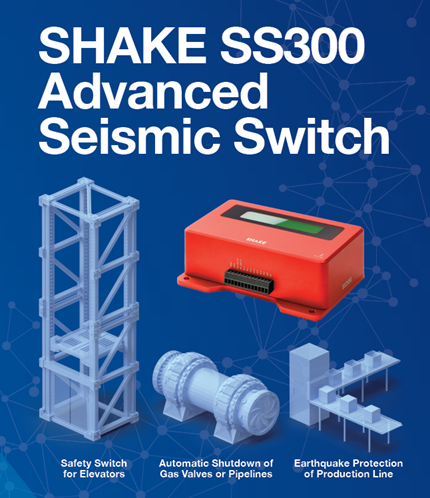
  • SHAKE SS300 (Smart Seismic Switch): SHAKE SS300 is a smart seismic switch designed for automatic earthquake-triggered safety control, using MEMS-based sensing and configurable relay outputs to activate emergency systems. It is built for rapid response applications such as shutdown control, alarms, and infrastructure protection through configurable seismic thresholds and communication protocols.
2.3 PX01 – Smart central data logger

The PX01 is a central unit designed to connect and manage multiple seismic accelerometer recorder devices in one system. It collects data from sensors, processes trigger logic, and controls automated responses. This makes it a key component in systems that require reliable decision-making and fast alerts.

The PX01 works as a bridge between field sensors and control platforms. It receives seismic signals, applies logic rules, and sends commands or notifications. You can use it in industrial sites, infrastructure projects, and seismic monitoring networks where multiple sensors must act as one system.

Key features :
  • Rack-mounted 1U design: Fits standard control cabinets and supports stable operation in industrial environments.
  • Supports up to 5 sensors: Connects multiple seismic accelerometer recorder units for centralized monitoring.
  • N-of-M voting algorithm: Triggers alerts only when a defined number of sensors detect an event. This reduces false alarms.
  • Relay control for automated response: Activates external systems such as alarms, shutdown controls, or safety mechanisms.
  • Modbus protocol support: Integrates with SCADA and MES systems for industrial control.
  • SeedLink protocol support: Allows connection with third-party seismic networks and data platforms.

3. Applications of Seismic and Vibration Monitoring Systems

Seismic and vibration monitoring systems measure ground motion and structural response, converting physical signals into real-time, actionable data. Depending on the application, key requirements include trigger response time, dynamic range, measurement accuracy, communication reliability, and control output capabilities.

Sanlien systems are designed for four core application domains, each with specific technical requirements and deployment scenarios.

Earthquake early warning (EEW)
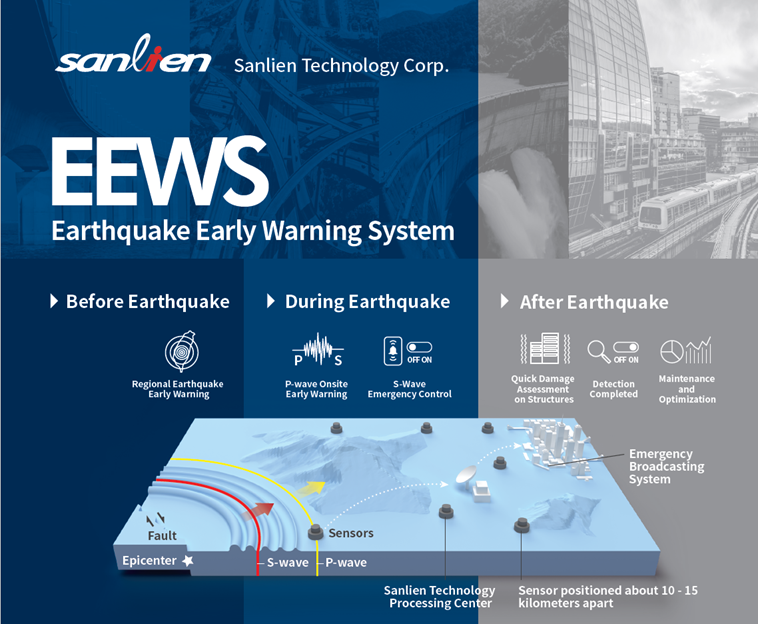
Sanlien Technology_Earthquake Early Warning System

EEW (Earthquake Early Warning) is a highly time-critical application. The system detects the initial P-wave and issues alerts before the arrival of destructive S-waves, with warning time depending on epicenter distance and network geometry.

The Pd (peak displacement) method analyzes the first ~3 seconds of P-wave data to estimate earthquake size and expected ground motion. If the predicted ground motion intensity exceeds predefined thresholds, alerts are issued and relay outputs can activate automated safety responses such as elevator shutdown or gas valve closure.

Deployment requires optimized station spacing based on seismic risk and coverage design, stable installation conditions, GPS time synchronization, multi-server data transmission, and comprehensive system validation and testing.

Recommended hardware: pALERT F330, pALERT Q332

 
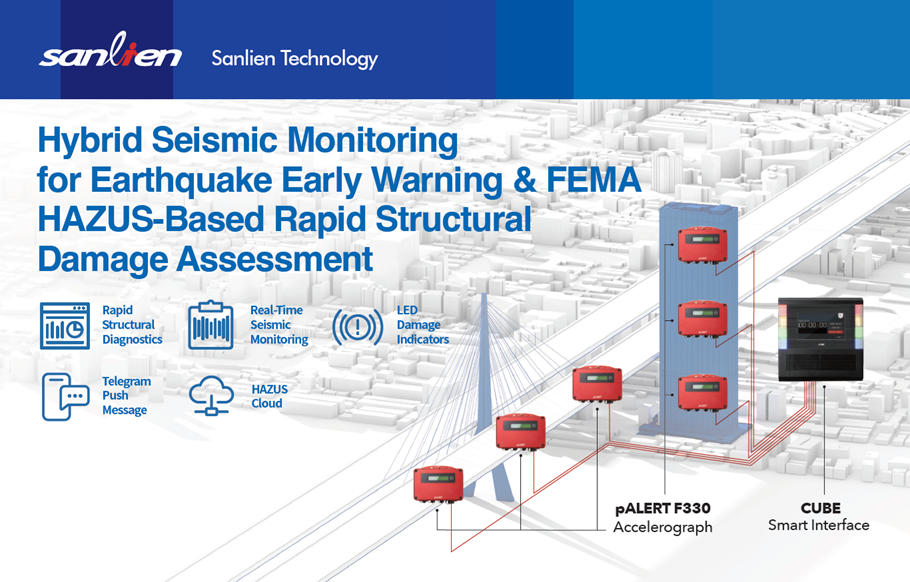
Structural health monitoring (SHM)
Sanlien Technology_Structural Health Monitoring

SHM evaluates how structures respond to seismic and ambient vibrations to detect damage or degradation at an early stage. It applies to buildings, bridges, dams, tunnels, and retaining walls.

Key measurements include Peak Ground Acceleration (PGA), modal frequency shifts, and inter-story drift ratios. Sensors are typically installed at critical structural locations (base, mid-level, and top) to capture modal behavior and vibration responses.

System design involves defining monitoring objectives, selecting sensor locations, configuring data acquisition and logging systems, and establishing baseline structural conditions for post-event comparison.

Post-event analysis focuses on acceleration peaks, changes in modal frequencies (indicating potential stiffness loss), and inter-story drift ratios exceeding design limits.

Recommended hardware: SHAKE SD300

Industrial disaster prevention
Sanlien Technology_Advanced Seismic Switch

Industrial disaster prevention systems use seismic and vibration monitoring to detect abnormal motion and trigger automatic shutdowns, helping prevent equipment damage and secondary disasters such as fire, leakage, or explosion.

Because industrial facilities experience continuous operational vibration, ambient vibration monitoring is used to establish a baseline noise profile and reduce false triggering. Alarm thresholds are then defined above normal operating vibration levels with appropriate safety margins.

Deployment includes hazard assessment, optimal sensor placement, ambient vibration baseline recording (typically over a representative operating period), integration with control and relay systems, and full response testing to ensure reliable activation during abnormal events.

Recommended hardware: SHAKE SS300

Seismic observation networks

Seismic observation networks consist of geographically distributed accelerographs and monitoring stations that continuously acquire and transmit ground motion data for earthquake detection, seismic analysis, and early warning applications.

Each station records waveform data in continuous mode, synchronizes timing through GPS or NTP, and streams data to a central processing system using industry-standard protocols such as SeedLink. By combining observations from multiple stations, the network can rapidly estimate earthquake location, magnitude, and intensity distribution.

System deployment requires protocol interoperability, accurate time synchronization, continuous data acquisition, reliable communications infrastructure, and validation of real-time data delivery and processing.

Recommended hardware: pALERT F330, pALERT Q332

4. Why Choose Sanlien Seismic and Vibration Monitoring Solutions?

Sanlien provides a comprehensive portfolio of seismic and vibration monitoring solutions for real-time monitoring, earthquake early warning, structural health monitoring, and industrial safety applications. The portfolio spans sensing, data acquisition, recording, communication, analysis, and automated response, with each component designed to operate within a unified system architecture. This integrated approach simplifies deployment, reduces integration risk, and enhances long-term system reliability.

When selecting a seismic and vibration monitoring solution, key considerations include measurement accuracy, system interoperability, scalability, and long-term operational stability. Sanlien addresses these requirements through certified calibration services, open communication protocols, and decades of experience in real-world deployments, helping organizations make informed and safety-critical decisions with confidence.

  • Certified calibration capability: Sanlien operates a TAF-certified calibration center, ensuring sensors and monitoring systems meet defined performance and measurement standards.

  • IoT-ready architecture: Devices support industry-standard protocols such as SeedLink, Modbus, and NTP, enabling seamless integration with seismic networks, monitoring platforms, and industrial control systems.

  • Multi-standard intensity support: Sanlien solutions support multiple seismic intensity scales, including MMI, JMA, KMA, CEA, and CWB, allowing deployment across different regions and regulatory frameworks.

  • Proven field deployments: Sanlien technologies are deployed in seismic observation networks, infrastructure monitoring projects, industrial facilities, and earthquake early warning systems, demonstrating reliable performance under real-world conditions.

  • End-to-end solution provider: From sensors and monitoring devices to data acquisition systems, software platforms such as SanDAS, and field support services, Sanlien delivers a complete monitoring ecosystem from a single source.

Accurate and reliable monitoring data is essential for earthquake preparedness, infrastructure resilience, and operational safety. Sanlien supports these objectives through rigorous calibration, precise time synchronization, and comprehensive system validation.

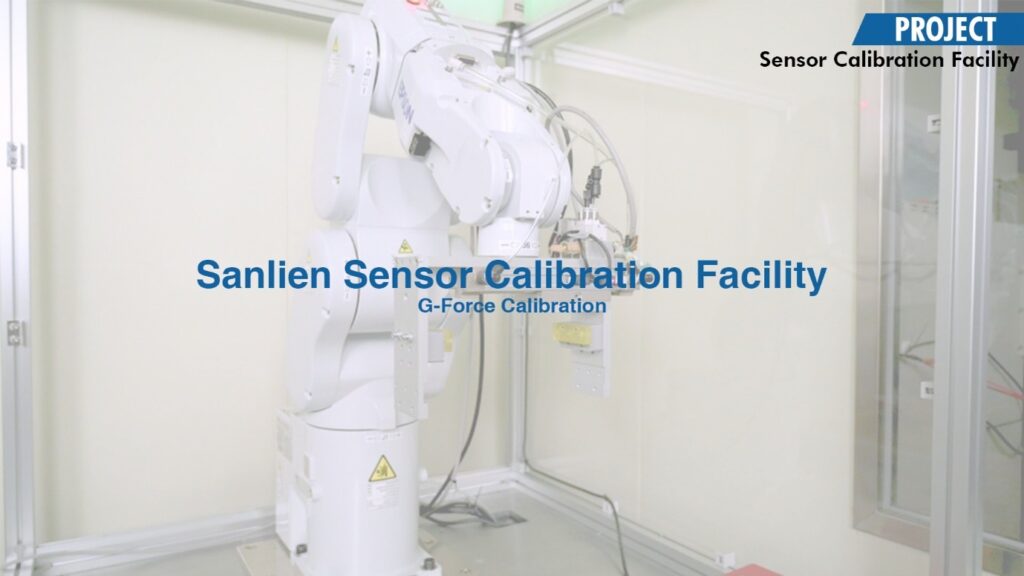
Calibration and verification
  1. Each device is tested and calibrated in a certified laboratory.
  2. Calibration is performed according to documented procedures and standards.
  3. Results are recorded and maintained for traceability.
  4. Device performance is verified before deployment.
  5.  

This process helps ensure that recorded acceleration measurements remain accurate, reliable, and consistent over time.
Sanlien Technology_ Sensor Calibration Facility
Time Synchronization
  1. Devices synchronize time using GPS or NTP.
  2. All monitoring units operate with a common time reference.
  3. Data from multiple locations can be accurately correlated and analyzed.


Precise time synchronization is essential for earthquake detection, waveform analysis, and event localization.

Seismic and vibration monitoring requires more than a single device. Effective monitoring systems combine sensing, data acquisition, communication, analysis, and automated response to provide timely and reliable information for decision-making. Selecting the right solution depends on measurement accuracy, system reliability, and seamless integration across the entire monitoring network.

Sanlien offers a comprehensive portfolio of seismic and vibration monitoring solutions, including network accelerometers, accelerographs, accelerometers, seismic switches, data loggers, and software platforms. Designed to operate within a unified architecture, these solutions support applications ranging from earthquake early warning and seismic observation to structural health monitoring and industrial safety.

Whether you are building a new monitoring network or upgrading an existing system, Sanlien provides the technical expertise, system integration support, and field-proven technologies needed to meet your project requirements with confidence.