4. Key concepts in vibration measurement
To manage construction vibration effectively, you need to understand how it is measured. While the technology behind vibration sensors can be complex, the key concepts are actually quite straightforward. In most construction projects, three main parameters are used: PPV (Peak Particle Velocity), acceleration, and frequency.
PPV (Peak Particle Velocity) is the most important metric—and the one most widely used in construction safety. It measures how fast particles in the ground are moving when vibration passes through, typically expressed in mm/s. In simple terms, PPV tells you how “strong” the vibration is. Because it directly correlates with the potential for structural damage, most safety standards and guidelines are based on PPV limits. That’s why it’s considered the core metric in vibration monitoring.
Acceleration measures how quickly that movement is changing. It’s often used in more advanced analysis or in applications where sensitive equipment or human perception is a concern. While useful, it’s generally less central than PPV in construction contexts.
Frequency refers to how fast the vibration cycles occur (measured in Hz). This matters because different structures respond differently to various frequencies—some may amplify vibration if resonance occurs.
Together, these three parameters provide a clear picture of vibration behavior, but in most cases, PPV is the primary value used to assess safety and risk on site.
5. Vibration limits and safety standards
To control vibration effectively, construction projects rely on established standards that define safe vibration limits. These guidelines help engineers determine when vibration is acceptable and when it becomes a risk to structures or people. While there is no single global standard, several widely recognized references are commonly used, including AS 2670.2 (Australia), DIN 4150-3 (Germany), and BS 7385 (UK).
AS 2670.2 focuses on human exposure to vibration, particularly comfort and potential health effects. It defines acceptable vibration levels (often using VDV) based on building type and time of day—for example, stricter limits at night in residential areas to reduce disturbance.
DIN 4150-3 is one of the most widely used standards for structural protection. It sets PPV-based limits depending on building categories:
- Higher limits for industrial structures (up to ~50 mm/s)
- Lower limits for residential buildings (around 5–20 mm/s)
- Even stricter thresholds for sensitive or historic structures
BS 7385 also focuses on preventing building damage, with limits that vary depending on both structure type and vibration frequency. For example, reinforced buildings can tolerate higher PPV levels than lightweight residential structures.
Each standard was developed based on local conditions, research methods, and regulatory priorities. Some emphasize human comfort, while others prioritize structural integrity. As a result, engineers often reference multiple standards depending on project requirements.
6. How is vibration monitored on construction sites?
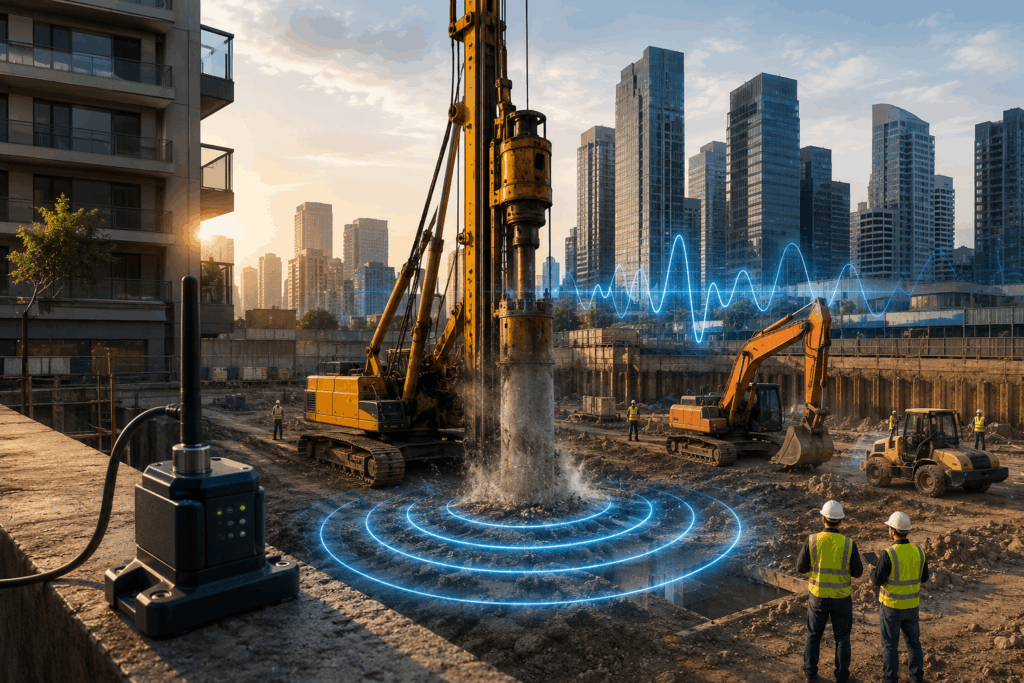
In modern construction, vibration monitoring is a structured process designed to turn raw ground movement into actionable insights.
At its core, it follows a simple workflow: measure → record → analyze → alert. Each step plays a critical role in ensuring vibration stays within safe limits.
Measure
Vibration sensors (such as geophones or triaxial velocity sensors) are installed at key locations to capture ground movement in real time, including PPV, frequency, and acceleration.
Record
A data acquisition system (DAQ) collects and stores the sensor data continuously, either locally or via cloud-based platforms for remote access.
Analyze
The recorded data is processed and compared against predefined vibration limits based on project requirements or relevant safety standards.
Alert
If vibration levels exceed safe thresholds, the system automatically triggers alerts, such as alarms, notifications, or reports, so the project team can take immediate action.
This step-by-step approach ensures vibration is not just observed, but actively controlled throughout the construction process.
If you want to explore vibration monitoring in more depth, especially how different vibration sensors, technologies, and systems work in real-world construction, check out our article Construction Safety Vibration: A Guide to Sensors, Technologies, and Monitoring Systems. It provides a clearer look at sensor types, how data is collected and processed, and how modern monitoring solutions help improve safety, accuracy, and compliance on site.
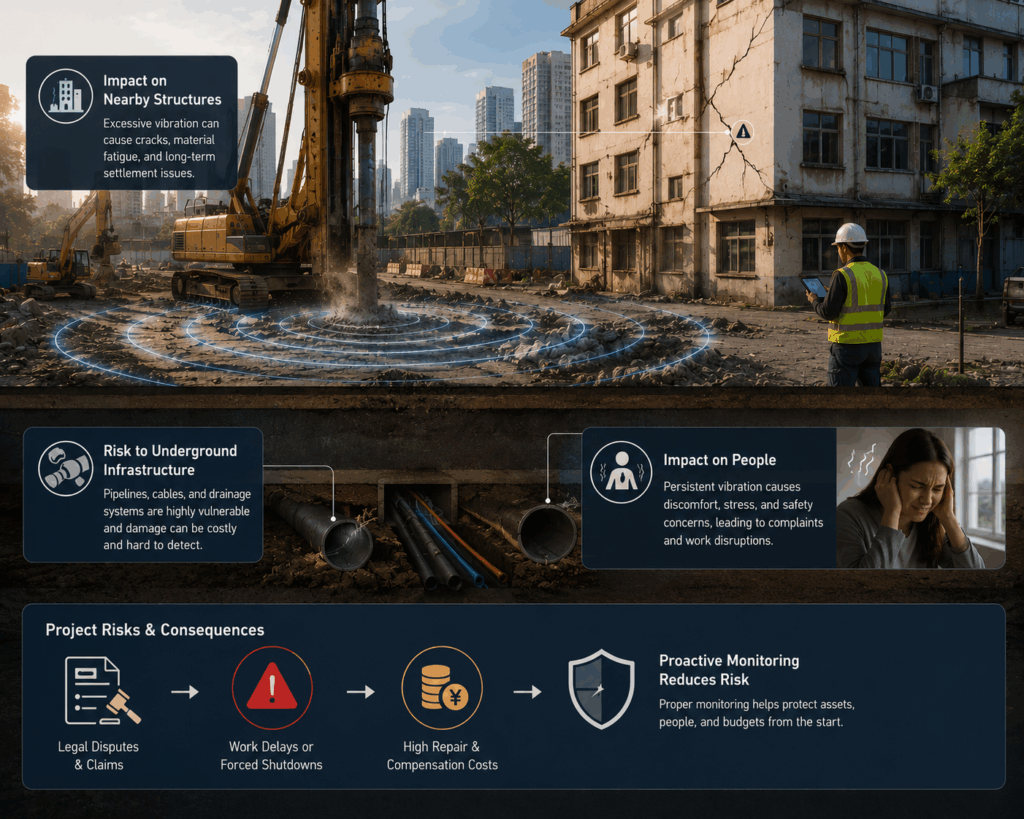
Construction vibration is inevitable, but the risks it creates can be controlled with the right knowledge and tools. By understanding how vibration is generated, how it affects structures and people, and how it is measured, project teams can take a more proactive approach to safety.
With proper monitoring systems, clear limits, and reliable data, vibration becomes a manageable part of the construction process. As projects become more complex and environments more sensitive, effective vibration control plays a critical role in protecting assets, maintaining compliance, and ensuring long-term project success.
If you’re looking to implement a reliable vibration monitoring solution, contact Sanlien for expert consultation and tailored systems designed for your project needs.